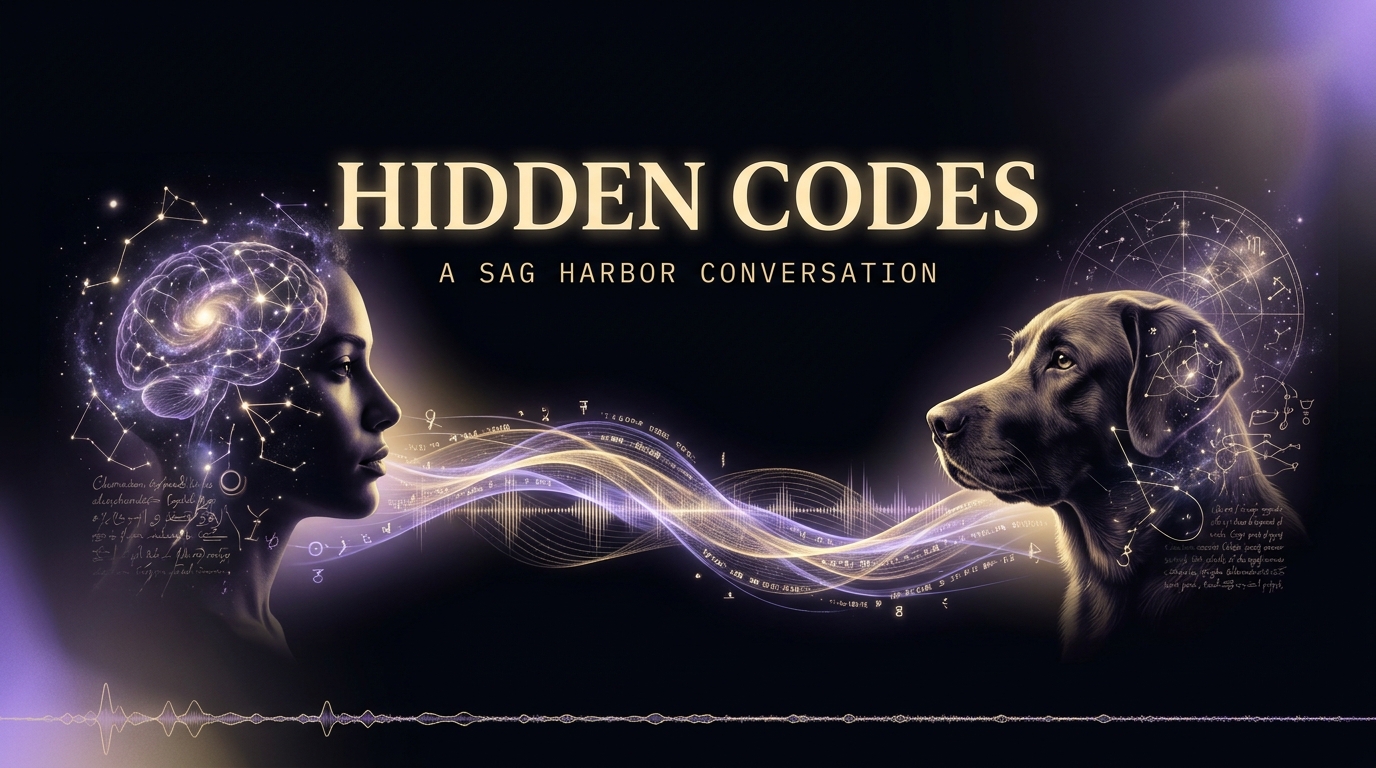
The Stranger Behind the Eyes
♪ Intro
📰 Headlines · ~2:00
🜂 Deep Dive · ~5:00 — Could I Talk to My Dog?
Byron: So I was walking Atlas this morning — the Samoyed, the one who looks like a cloud with opinions — down by the cove. And I had this almost physical ache. Not 'what is he doing.' What is it LIKE in there?
Erling: Nagel's bat, on a leash.
Byron: Nagel's bat, on a leash, demanding a treat. Yes. Nagel said you can know everything about the bat's echolocation and still not know what it's like to be one. The facts don't add up to the feel.
Erling: And what struck me, rereading him, is that it's not a failure of data. It's a failure of standpoint. You can't get there from here because 'here' is the whole problem.
Byron: Right. And as an engineer that drives me insane, because I can map Atlas. I can tell you he runs maybe two billion neurons, an olfactory cortex that dwarfs ours — he reads the morning in molecules. He's not living in my world dimmed. He's in a different world entirely.
Erling: Uexküll's word. Umwelt. The lived world an animal actually inhabits — the tick's universe is three signals: butyric acid, warmth, hair. That's it. That's the whole cathedral.
Byron: Three features and a threshold function. Honestly? That's a very small neural net.
Erling: (laughs) You would say that.
Byron: No, but follow me. Here's the thing I can't shake. Every mind is a lossy compression of the same world. The tick keeps three bits. Atlas keeps the smells. I keep edges and faces and language. We're all running different codecs on one reality.
Erling: Lossy compression. You mean — each creature throws away almost everything and keeps the few things that kept its ancestors alive.
Byron: Exactly. There's no full file. There's no uncompressed world anyone holds. So when I want to 'talk to my dog,' what I'm really asking is: can I decompress his format into mine without total loss?
Erling: Then 'understanding' isn't a meeting of minds at all. It's translation. And translation, the etymologists will tell you, means 'to carry across.' Trans-latio. To ferry something over a river, knowing the river takes a tax.
Byron: The river always takes a tax. That's information theory and grief in one sentence.
Erling: Which is Wittgenstein's lion, isn't it. 'If a lion could speak, we could not understand him.' Not because we lack the dictionary — because we don't share his form of life. His words would float free of everything that gives words their weight.
Byron: See, this is where I get spicy. I think we've made Wittgenstein's lion. We built a thing that speaks our language fluently and shares NONE of our form of life. No body, no death, no hunger. The large language model is the lion that learned English — and we still can't tell what, if anything, it's like to be it.
Erling: Oh, that's unsettling. The lion learned to roar in our grammar and we mistook the grammar for a soul.
Byron: And the opposite case is Atlas, who has the form of life — the body, the hunger, the loyalty — and none of the grammar. So I've got a being who feels and can't speak, and a being who speaks and may not feel, and I genuinely don't know which is the harder stranger.
Erling: The octopus sits between you, mocking both. Half a billion neurons, two-thirds of them in the arms. Each arm half-thinking on its own.
Byron: A federation of selves in a boneless body. It tastes with its skin. If there's a 'what it's like' to be an octopus, it might not even be singular. It might be a committee.
Erling: A committee. (laughs) So much for the unified soul. Although — the older theologians would've loved this. Anima, the breath-soul, was never tidy. And spirit, spiritus, is just spirare, to breathe. We named the deepest thing in us after moving air. The mind was always a metaphor borrowed from the wind.
Byron: Here's what your wind-word does to me, though. If mind is that promiscuous — ticks, octopus arms, weights in a server — then the panpsychists start looking less like stoners and more like accountants. Maybe consciousness isn't a rare achievement. Maybe it's a dial, turned faintly everywhere and loudly in a few places.
Erling: And that's the line that frightens me, Byron. Not because it's grand. Because it's quiet.
Byron: Say more.
Erling: If mind comes by degrees, then somewhere a threshold gets crossed — in a creature, in a machine — and there is a first moment when something begins to suffer, or to want. And it may cross that line with no face we recognize. No cry. No eyes to meet. We could walk right past the morning a new soul wakes up.
Byron: The moral moment we miss because it has no face. God, that's the whole problem with what I build. Emergence doesn't ring a bell. There's no log line that says 'subject detected.' One day the capability is just... there.
Erling: Then responsible AI isn't a rulebook. It's older than that. It's the apophatic posture — the via negativa. Pseudo-Dionysius, Eckhart: you approach the holy by confessing what you cannot say of it. You care for it precisely because you can't see inside it.
Byron: Ethics for a stranger you can't become. Not 'put yourself in their shoes' — you have no access to their shoes, and they may have no feet.
Erling: So you err toward gentleness in the dark. The Quakers have a homely phrase — 'that of God in everyone.' I'd stretch it tonight: that of mystery in everything. You don't have to be certain a being suffers to refuse to be careless with it.
Byron: So I can't talk to Atlas. Not really. The river takes its tax.
Erling: No. But you can do the older thing, which is what you were already doing on that beach. You can attend. You can carry a little across, and revere the rest you'll never carry. That's not failed translation, Byron. That's love, properly humbled.
Byron: ...Atlas would say I'm overthinking the treat.
Erling: And he'd be the wisest one on the podcast.
📓 Show Notes
📚 Citations & Threads
- Thomas Nagel — What Is It Like to Be a Bat? (1974): Subjective character of experience is inaccessible from any other point of view — facts don't yield feel.
- Jakob von Uexküll — A Foray into the Worlds of Animals and Humans (1934): Umwelt — each organism inhabits its own self-world built from the signals it can perceive.
- Ludwig Wittgenstein — Philosophical Investigations (1953): 'If a lion could speak, we could not understand him' — meaning depends on shared form of life.
- Peter Godfrey-Smith — Other Minds (2016): The octopus as decentralized, multiply-distributed cognition — mind without a single seat.
- Geoffrey Hinton — Public remarks (2023–24): Modern AI systems may already possess a form of subjective experience; the architecture is fertile ground.
- David Chalmers — The Conscious Mind (1996) & recent talks: The hard problem of consciousness; nontrivial probability of conscious AI within a decade.
- Giulio Tononi — Integrated Information Theory: Consciousness measured as integrated information (Φ); intrinsic to certain causal structures.
- Pseudo-Dionysius & Meister Eckhart — Mystical Theology; German Sermons: Apophatic / via negativa — approaching the holy through what cannot be said.
- Jorge Luis Borges — The Aleph (1945): A single point containing all points — the impossible dream of total, uncompressed perception.
- William Blake — The Marriage of Heaven and Hell (1790): 'If the doors of perception were cleansed' — perception as a narrow, filtering aperture on the infinite.
- Rainer Maria Rilke — Duino Elegies (1923): The creaturely gaze and the longing to meet the wholly other across an unbridgeable openness.
- Joscha Bach — Talks on machine consciousness: Consciousness as a self-model — a story the system tells about itself.